About Xubin Ren
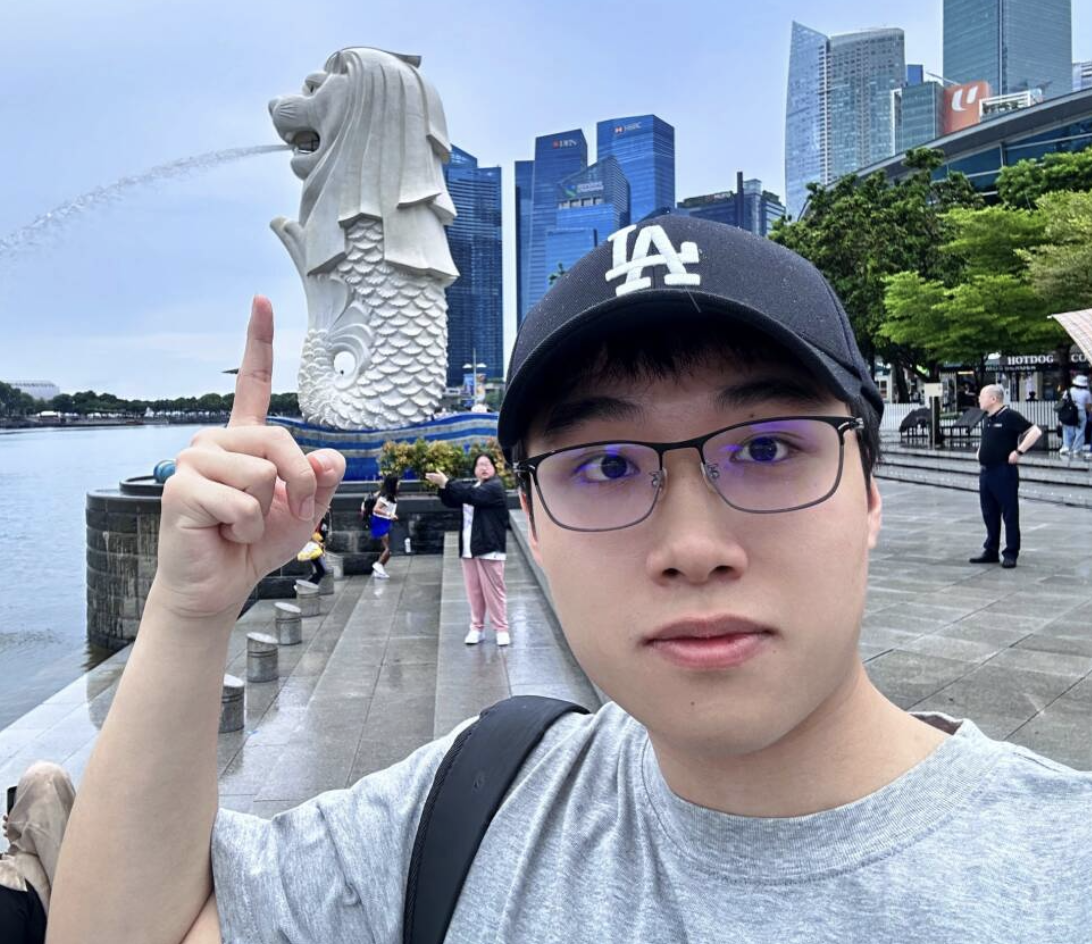
Hi, I’m Xubin Ren. I’m a Ph.D. candidate at the Institute of Data Science, The University of Hong Kong, advised by Prof. Chao Huang and Prof. Benjamin C. M. Kao.
I began doing research at Wuhan University, where I studied Computer Science and Technology and worked with Prof. Zhenzhong Chen at the IIP Lab. Since then, my questions have moved toward large language models, information retrieval, and AI agents: how can a system find the right context, reason with it, and still be useful in the real world?
I like research most when it grows beyond a paper. nanobot is my attempt to turn that instinct into an open-source system people can actually use.
Along the way, I’ve been honored as an AI25 AI Innovation Pioneer Under 25, a BAAI InnoVibe 2026 Most Notable Academic Rising Star, and a CAAI Rising Scientist.
xubinrencs AT gmail.com GitHub Twitter LinkedIn Google Scholar
Recent updates
- Grateful to be named an AI25 AI Innovation Pioneer Under 25!
- Grateful to receive the BAAI InnoVibe 2026 Most Notable Academic Rising Star award!
- One long paper, MiniRAG, is accepted by ACL'26!
- One full paper is accepted by KDD'26!
- Grateful to receive the Ant InTech Scholarship - Future!
- One survey paper is accepted by ACM TIST!
- Two papers are accepted by EMNLP'25!
- Grateful to receive the WAIC Youth Outstanding Paper Nomination Award!
- One survey paper is accepted by ACM Computing Surveys!
Earlier updates
- Grateful to be selected as the CAAI Rising Scientist!
- One paper is accepted by EMNLP'24!
- One survey is accepted by KDD'24!
- One full paper and a tutorial are accepted by WWW'24!
- Two full paper (oral presentation) are accepted by WSDM'24!
- One long paper is accepted by CIKM'23!
- Graduated from Wuhan University with Honor!
- Two full papers are accepted by SIGIR'23!
- Awarded the HKPF and HKU-PS! Thanks all!
- One paper is accepted by ICLR'23!
- One paper is accepted by ACM TOIS!
- Awarded the National Scholarship for the fourth time! Thanks all!
- Awarded the CCF Elite Collegiate Award! Thanks all!
- Awarded the Finalist Winner in Mathematical Contest in Modeling (MCM)! Thanks all!
What I build

nanobot is where most of that thinking has converged. It began as an experiment in how little machinery a useful personal agent really needs. The project has since outgrown that early constraint: today it is an open-source, self-hosted agent framework that runs in a WebUI, terminal, and chat apps, with tools, memory, MCP integrations, multi-agent workflows, and automation. The goal is no longer to hit a line-count target; it is to keep the core legible while the system and its community grow.






Before either of them, there was SSLRec. Self-supervised recommendation had become a crowded research area, and I wanted one place where ideas could be reproduced and compared instead of living in isolated paper repositories. It became a shared PyTorch framework—and my first lesson that research code can be useful beyond its original experiment.


I like building things that start as research questions and grow into something people can actually use.
Research
Publications & Awards →My long-term goal is artificial general intelligence: systems that can acquire knowledge, adapt through experience, and keep improving after deployment.
My research began with a narrower question: what can a model learn from behavior when supervision is sparse? DCCF (SIGIR 2023) learned the different intents behind user–item interactions, while SSLRec (WSDM 2024 · Oral) turned this line of work into a shared framework for building and evaluating self-supervised recommenders.
With RLMRec (WWW 2024) and EasyRec (EMNLP 2025), I began using language to give those behavioral representations more semantic structure. RLMRec aligned LLM-generated profiles with collaborative signals; EasyRec pushed the same idea toward text-based zero-shot recommendation.
The next bottleneck was not only learning from the data a model already had, but finding the right evidence when the necessary context was too large or missing. VideoRAG (KDD 2026) brought retrieval to extremely long videos; MiniRAG (ACL 2026 · Long) asked how much of that capability could remain when the model and the system had to stay lightweight.
That brings me back to the question I started with, now at the scale of agents: how can a deployed system turn new interactions into lasting knowledge and skills without forgetting what it already knows? This is the continual-learning problem I want to work on—and, for me, a necessary step toward AGI.
Education

The University of Hong Kong
Ph.D. in Data Science
2023 — Present
Wuhan University
B.Eng. in Computer Science and Technology
2018 — 2023
Selected honors
- AI25 AI Innovation Pioneer Under 25, 2026
- BAAI InnoVibe Academic Rising Star, 2026
- CAAI Rising Scientist, 2025
- Hong Kong PhD Fellowship, 2023
- National Scholarship, 2019–2022
Academic service
Reviewer: Information Fusion, ACM TOIS, ACM TKDD, ACM TKDE, ACM TIST, and IEEE TNNLS.
Program committees: NeurIPS, ICLR, ICML, KDD, WWW, WSDM, CIKM, RecSys, and ACL ARR.